
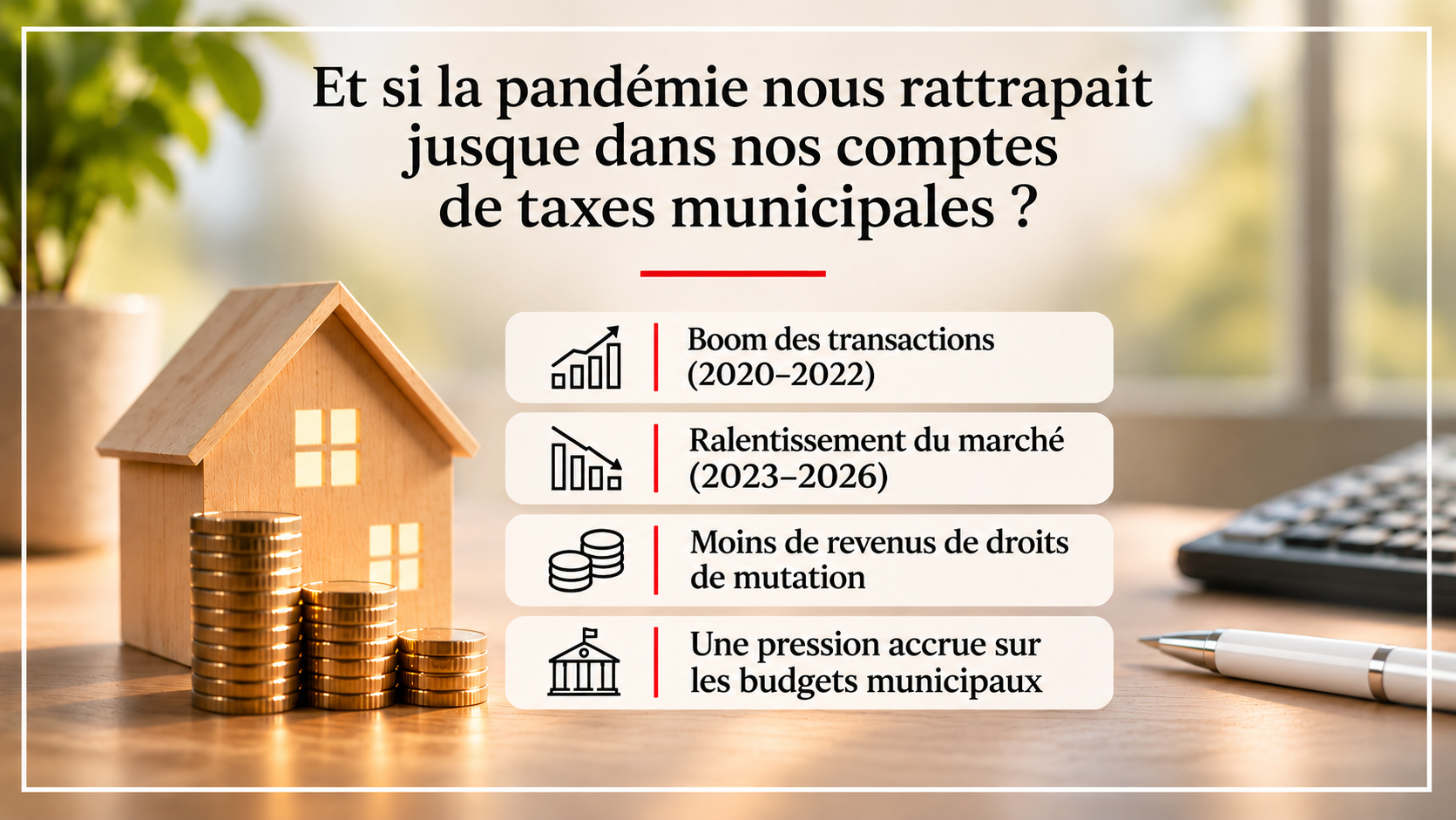
Could the slowdown in real estate transactions explain part of the increases in municipal taxes?
As several Quebec municipalities announce or hint at significant municipal tax increases, I believe it is worth dwelling on an economic phenomenon that is relatively little discussed: the decline in municipal revenue from real estate transactions since the pandemic period.
With some hindsight, it is worth asking what the medium- and long-term consequences of this unprecedented period are for the real estate market.
Particularly lucrative years for municipalities
The years 2020, 2021 and 2022 profoundly transformed Quebec’s real estate market. The enthusiasm for the regions, remote work, low interest rates and the search for a better quality of life triggered a remarkable surge in real estate activity, particularly in the Laurentians.
This period was marked by two simultaneous phenomena: a sharp increase in the number of real estate transactions and a considerable appreciation in property values.
For several municipalities, this combination represented an unprecedented financial opportunity. Revenue from real estate transfer duties, commonly known as the “welcome tax,” grew significantly, sometimes far exceeding budget forecasts.
More transactions, at higher prices, meant more revenue for municipal administrations, without necessarily having to increase the tax burden on owners already established in their territory.
A return to a degree of normality
Since 2023, the real estate landscape has changed considerably. The rise in interest rates, the decline in purchasing power and the return to a more balanced market have led to a slowdown in transactions in several municipalities, compared with the peaks reached during the pandemic.
Although property values generally remain high and some markets have since regained strength, the number of transactions has not necessarily returned to the exceptional levels of that period.
Yet fewer transactions can also mean less revenue for municipalities.
Unlike revenue from property taxation, transfer duties are a variable source of funding, directly influenced by the vitality of the real estate market and the value of the properties transferred.
When extraordinary revenue meets recurring expenses
This is where the question becomes particularly interesting.
To what extent did the additional revenue generated during the pandemic help sustain the growth of municipal spending, the development of new services or the completion of certain projects?
If part of this extraordinary revenue was used to fund expenses that have become recurring, its decline could now be creating additional pressure on municipal finances.
Let us take a purely hypothetical example:
| Year | Number of transactions | Transfer duty revenue |
|---|---|---|
| 2019 | 250 | $1,250,000 |
| 2020 | 400 | $2,400,000 |
| 2021 | 500 | $3,500,000 |
| 2022 | 350 | $2,800,000 |
| 2023 | 230 | $1,840,000 |
| 2024 | 250 | $2,050,000 |
| 2025 | 270 | $2,295,000 |
Illustrative simulation that does not represent any particular municipality.
In this example, revenue from transfer duties would have increased by 180% between 2019 and 2021, before falling by more than 34% between 2021 and 2025.
For a municipality with an annual budget of $25 million, this decrease of more than $1.2 million from the pandemic peak represents the equivalent of nearly 5% of its annual budget.
A financial gap that, depending on the municipality’s budget choices, may have to be made up in some other way.
A reality already visible in the Laurentians
This is not a purely theoretical question.
In Sainte-Adèle, when the 2024 budget was presented, a decrease of $332,380 in revenue from transfer duties was mentioned, while the average increase in municipal taxes stood at 4.84%.
In Sainte-Anne-des-Lacs, the discussions surrounding the 2025 budget also highlighted the importance of adopting cautious and stable forecasts for this source of revenue.
These examples illustrate how difficult it is for municipal administrations to forecast revenue so closely tied to fluctuations in the real estate market.
Owners called on to make up the difference?
It would obviously be simplistic to attribute the current increases in municipal taxes solely to the decline in real estate transactions.
Inflation, the rising cost of building and maintaining infrastructure, collective agreements, financing costs, environmental obligations and the growing needs of municipalities are also important factors.
However, the decline in revenue from transfer duties certainly deserves to be part of this discussion.
Municipalities that saw particularly strong growth in their revenue during the pandemic could now be facing a twofold challenge: dealing with less abundant real estate revenue while bearing expenses that, for their part, have continued to rise.
A delayed consequence of the pandemic real estate boom?
As a real estate broker, I see that the consequences of the pandemic for our market are not limited to the increase in property values, access to home ownership or the changing habits of buyers.
They could also show up, several years later, in the finances of our municipalities and, indirectly, in our tax bills.
It would be particularly interesting to analyze how our municipalities’ transfer duty revenue has evolved since 2019, to compare it with the growth of their spending and to measure its real impact on property tax increases.
Such an analysis would make it easier to understand whether the tax increases we are facing today are, in part, a delayed consequence of that period of intense real estate activity.
The pandemic will have profoundly transformed our real estate market. It is possible that we have not yet finished measuring all of its economic consequences.