
It is probably one of the most important questions any property owner asks: how much is my property really worth?
The answer seems simple: a property is worth what a buyer is willing to pay to acquire it, under normal market conditions.
Not necessarily the price you have in mind, nor the one suggested by your brother-in-law, an acquaintance or even your neighbour. The real value of a property rests above all on the meeting between a seller willing to sell and a buyer ready to buy.
And this nuance is fundamental!
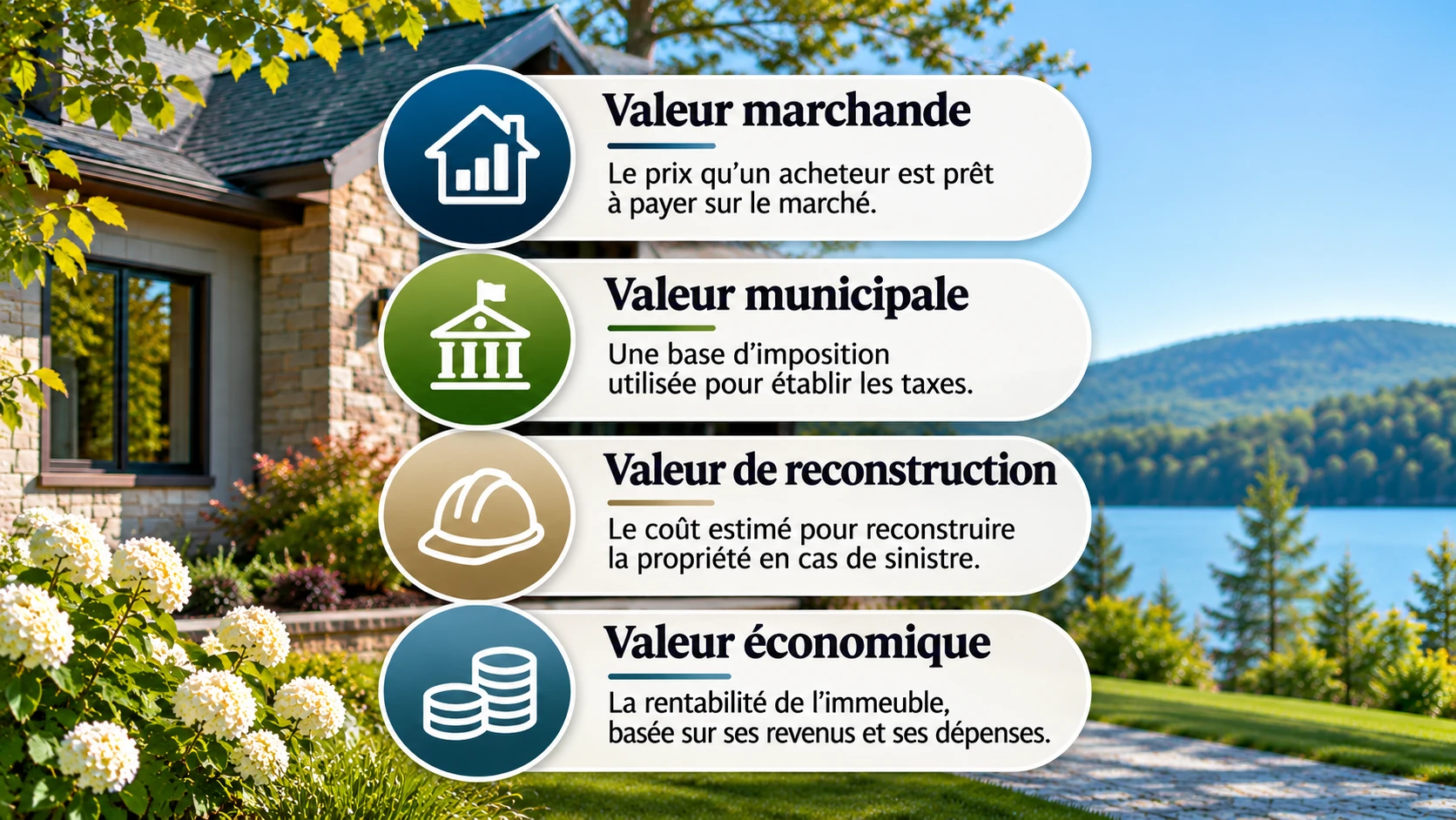
In real estate, there are several ways to establish the value of a property. I suggest we look at four of them, deliberately leaving aside emotional or sentimental value, which, although very real for an owner, does not necessarily translate into dollars on the market.
Market value
This is generally the one that interests us most when it comes to selling a property.
How much can I reasonably expect to get for my home under current market conditions?
To answer this question, real estate professionals, notably real estate brokers and certified appraisers, carry out a comparative market analysis.
This process consists of examining properties similar to yours, ideally located in the same area and sold recently. Depending on the type of property and how active the market is, we generally favour transactions concluded within the last three to six months, when the available data allow.
Each property is then analyzed taking its particular features into account: living area, lot size, quality of construction, general condition, number of bedrooms, renovations, pool, amenities and, of course, location.
Adjustments are made to account for the differences between the comparable properties and the one being analyzed.
The objective is to establish a realistic value range, based on actual transactions rather than mere perceptions.
It is important to remember that properties currently on the market represent sellers’ expectations, while sold properties reflect the prices buyers actually accepted.
This distinction is essential for setting a consistent and competitive listing price.
Municipal assessment
Well known to owners, the municipal assessment is frequently used as a reference point, by buyers and sellers alike.
It must be understood, however, that it serves a very different purpose from that of market value.
The municipal assessment is mainly used to establish the property tax base on which municipalities calculate municipal taxes.
In Quebec, this value is determined in accordance with the Act respecting municipal taxation. It generally reflects market conditions as of July 1 of the second year preceding the coming into force of the three-year assessment roll, that is, about 18 months earlier.
This assessment therefore does not necessarily represent the current value of your property.
One indicator sometimes used is to compare the sale price of similar properties with their municipal assessment.
Let’s take an example: a property sold for $1,000,000, with a municipal assessment of $800,000, has a ratio of 1.25 times its municipal value.
This ratio can provide a useful indication when it is established from several comparable transactions. It remains imperfect, however, particularly for distinctive properties, prestige residences or those enjoying an exceptional location.
The municipal assessment is therefore a reference tool, but certainly not a guarantee of market value.
Reconstruction value
Here is a concept that is often overlooked, yet essential for every owner.
Reconstruction value corresponds to the estimated cost of rebuilding a property after a major loss, such as a fire, using comparable materials and features.
Unlike market value, it is not based on the price a buyer would be willing to pay, but rather on actual construction costs.
It takes into account, among other things, materials, labour, current building standards, professional fees and the architectural particularities of the building.
This value may be higher or lower than market value, notably because the value of the land is generally not included in calculating the cost of rebuilding the building.
In a context where construction costs have changed considerably in recent years, it is particularly important to make sure your insurance coverage adequately reflects the current cost of reconstruction.
A property worth $1 million on the market could very well require $1.3 million to be rebuilt identically.
That is why a periodic review of your insurance coverage remains an excellent precaution.
Economic value, or income value
When it comes to income properties, whether residential, commercial or industrial, another approach becomes key: economic value, often called income value.
Here, the analysis no longer rests solely on the physical characteristics of the building, but mainly on its ability to generate income.
In concrete terms, how much does this building really bring in once its operating expenses are deducted?
To determine this, we analyze the rental income, from which we subtract operating expenses: municipal and school taxes, insurance, maintenance, management and other costs necessary to operate the building.
Allowances may also be considered for vacancy periods, bad debts and certain future expenses.
The result establishes the net operating income, a fundamental indicator for assessing the profitability of a real estate investment.
Financial institutions attach great importance to it, since it helps determine the building’s ability to support its financing. Other factors, notably the down payment, the quality of the borrower and credit conditions, also come into play.
In the industry, several tools make it possible to compare income properties, including:
- The GIM (gross income multiplier), which establishes a ratio between the price of the building and its gross income.
- The NIM (net income multiplier), which compares the price of the building with its net operating income.
- The capitalization rate, which relates net operating income to the value of the building.
- The price per unit, particularly useful for comparing similar multi-residential buildings.
Of course, ratios vary according to location, the quality of the building, its condition, its optimization potential and the number of units.
You cannot reasonably analyze a triplex the same way as a 24-unit building!
Supply and demand: the real engine of the real estate market
Beyond these different valuation methods, one fundamental economic principle constantly influences property values: the balance between supply and demand.
We all witnessed the real estate bidding wars of 2021 and 2022.
At that time, the number of buyers far exceeded the number of properties available. This pressure led to a rapid rise in prices, sometimes well beyond the values initially anticipated.
Conversely, when the number of properties on offer increases and buyers become more cautious, selling times can lengthen and sellers must sometimes revise their expectations.
But be careful: a slowdown in the number of transactions does not automatically mean a significant drop in values.
This is a distinction I consider particularly important.
Even when mortgage rates rise and activity slows, prices can remain relatively stable if the available inventory stays limited relative to demand.
Moreover, the real estate market does not evolve uniformly. Entry-level properties, family homes, recreational properties and prestige residences can experience very different realities, sometimes within the same municipality.
That is why a good knowledge of the local market, its particularities and the transactions actually concluded remains indispensable.
In conclusion: one value, several perspectives
After more than 20 years in the Laurentians real estate market, one thing remains certain in my eyes: there is no magic formula for determining the value of a property.
Statistics, comparables and valuation methods are essential tools. But their true value lies in the ability to interpret them accurately, taking into account the particularities of each property and the constant evolution of the market.
A property may have a price, but it is the market that ultimately confirms its value.
Would you like to better understand the value of your property or learn about the real estate trends currently influencing our region?
I would be happy to share my analysis of the Laurentians market with you and to support you in your thinking, whether you plan to sell soon or simply wish to better understand the value of your real estate assets.
Feel free to contact me by email or by phone. It will be a pleasure to speak with you.